GST Compliance Guide for First-Time GST Registrants: Month-by-Month Checklist
Getting a GST registration is only the first step. Many new business owners believe that GST compliance ends after obtaining the GSTIN. However, GST is a continuous compliance process that requires regular return filing, tax payment, invoice management, and reconciliation.
Failure to comply can result in late fees, interest, notices, and restrictions on Input Tax Credit (ITC). Therefore, every GST-registered business should follow a structured monthly compliance calendar.
This guide explains the month-by-month GST compliance requirements for first-time GST users in a simple and practical manner.
Step 1: Understand Your GST Compliance Responsibility
Once you obtain GST registration, you must:
- Issue GST-compliant invoices
- Collect GST from customers (if applicable)
- Maintain purchase and sales records
- File GST returns on time
- Pay GST liability within due dates
- Reconcile Input Tax Credit regularly
Even if there are no sales or purchases during a month, GST returns may still need to be filed as Nil Returns.
Monthly GST Compliance Checklist
Throughout the Month
1. Issue Proper Tax Invoices
Every GST invoice should contain:
- GSTIN
- Invoice Number
- Invoice Date
- Customer Details
- HSN/SAC Code
- Taxable Value
- CGST, SGST or IGST
- Total Invoice Value
Proper invoicing helps avoid future GST notices.
2. Record All Purchases
Maintain copies of:
- Vendor invoices
- E-way bills
- Credit notes
- Debit notes
These documents support your ITC claims.
3. Verify Vendor GST Compliance
Before claiming Input Tax Credit:
- Ensure supplier has a valid GST registration.
- Verify that supplier has uploaded invoices correctly.
- Match invoices with GSTR-2B.
Month-End Activities
At the end of every month:
Reconcile Sales Data
Compare:
- Accounting software records
- GST invoices issued
- E-invoices (if applicable)
- E-way bills
Any mismatch should be corrected before filing returns.
Reconcile Purchases and ITC
Check:
- Purchase register
- GSTR-2B
- Vendor invoices
Claim only eligible ITC.
Important GST Return Due Dates
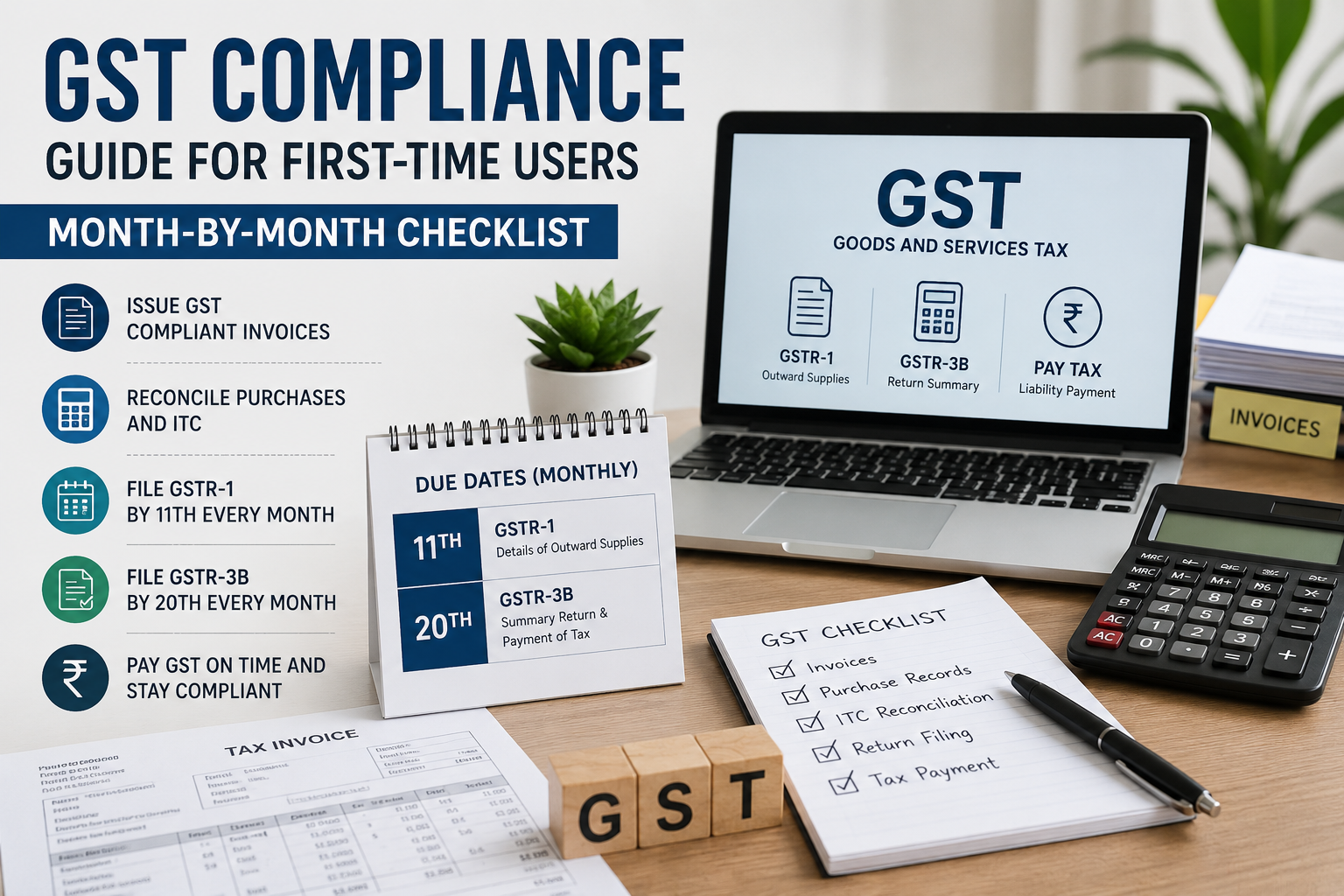
GSTR-1
GSTR-1 contains details of outward supplies (sales invoices). It is required for reporting sales made during the month.
Typical Due Date:
- 11th of the following month
Example
For sales made in April:
- GSTR-1 Due Date: 11th May
GSTR-3B
GSTR-3B is a summary return used to declare GST liability, claim ITC, and pay tax. All normal taxpayers are generally required to file it.
Typical Due Date:
- 20th of the following month
Example
For April transactions:
- GSTR-3B Due Date: 20th May
Annual GST Compliance
At the end of the financial year:
GSTR-9
Many regular taxpayers must file an annual GST return summarizing yearly transactions.
Annual Reconciliation
Review:
- Sales turnover
- Tax paid
- ITC claimed
- Books of accounts
- GST returns filed
This helps identify and rectify discrepancies before departmental scrutiny.
Common Mistakes Made by First-Time GST Users
Claiming Excess ITC
Claim ITC only when:
- Valid tax invoice exists.
- Supplier has uploaded invoice.
- ITC appears in GSTR-2B.
Missing Return Due Dates
Late filing attracts:
- Late fees
- Interest on delayed tax payment
- Compliance notices
Mismatch Between GSTR-1 and GSTR-3B
GST authorities increasingly compare sales reported in GSTR-1 with tax liability reported in GSTR-3B. Mismatches may trigger notices and compliance issues.
Ignoring Nil Returns
Even when there are no transactions, required GST returns should generally be filed to avoid penalties.
Practical GST Compliance Calendar
| Date | Activity |
|---|---|
| Daily | Issue GST invoices and record expenses |
| Month End | Reconcile sales and purchases |
| Before 10th | Review books and GST data |
| 11th | File GSTR-1 |
| 20th | File GSTR-3B and pay GST |
| Year End | Annual GST review and GSTR-9 filing |
How a Chartered Accountant Can Help
A professional GST consultant can assist with:
- GST Registration
- Monthly GST Return Filing
- GST Notices & Assessments
- GST Audit Support
- ITC Reconciliation
- Annual GST Compliance
This ensures timely compliance and reduces the risk of penalties.
Conclusion
GST compliance is not a one-time activity. It is a continuous process that requires proper invoicing, regular reconciliation, timely tax payment, and accurate return filing.
For first-time GST users, following a structured monthly compliance calendar can prevent costly mistakes and keep the business fully compliant. If you are unsure about GST filing requirements, consulting an experienced GST professional can save both time and money.
Need help with GST Registration, Return Filing, GST Notices, or GST Advisory Services? Contact CA in Bangalore for expert GST compliance support.