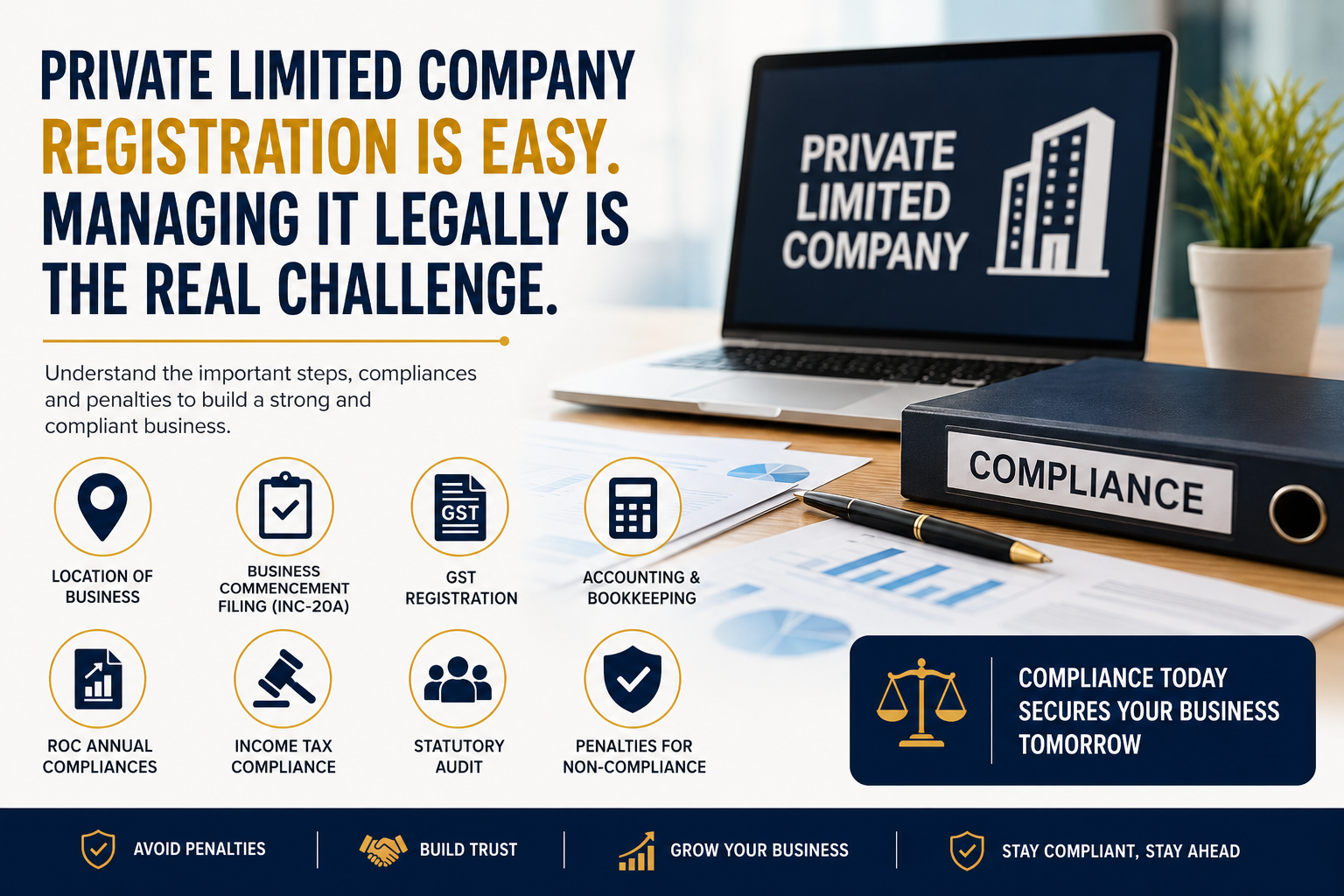
Private Limited Company Registration is Easy. Managing It Legally is the Real Challenge.
Many entrepreneurs believe that once a Private Limited Company is incorporated, the difficult part is over. They compare incorporation fees, choose the cheapest service provider, and assume that all legal compliances are simple formalities.
Unfortunately, this misconception costs businesses much more in the long run.
A Private Limited Company is governed by the Companies Act, 2013, the Income-tax Act, GST laws, labour laws, and several other regulatory requirements. Failure to comply can result in penalties running into lakhs of rupees, director disqualification, notices from government departments, difficulties in obtaining loans, rejection of tenders, and even strike-off of the company.
This article explains the most important compliances immediately after incorporation, the penalties for non-compliance, and why choosing the right professional partner is far more important than choosing the cheapest incorporation package.
Step 1 – Choosing the Registered Office Carefully
One of the biggest mistakes made by new business owners is using any available address merely for incorporation.
The registered office is the official address of the company where all communications from the Ministry of Corporate Affairs (MCA), Income Tax Department, GST Department, banks and other statutory authorities are sent.
The registered office should be capable of receiving government notices and maintaining statutory records.
Why is the Registered Office Important?
- It determines the jurisdiction of the Registrar of Companies (ROC).
- All legal notices are considered valid if delivered to the registered office.
- GST registration verification is linked with the business location.
- Banks often verify the office before opening current accounts.
- Government tenders and financial institutions frequently verify the business address before awarding contracts or sanctioning loans.
Failure to maintain or update the registered office can result in notices, penalties and unnecessary legal complications.
Step 2 – Business Commencement Filing (INC-20A)
Many directors believe that receiving the Certificate of Incorporation means they can immediately start business operations.
This is incorrect.
Every company having share capital incorporated after 2 November 2018 must file Form INC-20A (Declaration for Commencement of Business) within 180 days from incorporation after the subscribed share capital has been deposited into the company’s bank account.
Penalty for Non-filing
Company: ₹50,000
Every Officer in Default: ₹1,000 per day during the period of default subject to a maximum of ₹1,00,000.
Apart from monetary penalties, the Registrar of Companies may initiate action for removal of the company’s name if the company fails to commence business within the prescribed period.
Step 3 – Opening the Company Bank Account
The company bank account is not merely a banking requirement.
It is mandatory for:
- Deposit of Share Capital
- Filing INC-20A
- GST Registration
- Accounting
- Income Tax Compliance
- Audit
- Vendor Payments
Many businesses continue using personal bank accounts for business transactions, which creates accounting, taxation and audit issues in future.
Step 4 – GST Registration – Not Just Obtaining a GST Number
One of the most common misconceptions among startups is that GST registration is simply another certificate.
In reality, obtaining GST registration is only the beginning.
Professional advice is essential before applying because selecting incorrect business activities, HSN/SAC codes, place of business, or registration category can create years of compliance issues.
Common Mistakes
- Delayed GST Registration
- Wrong Business Address
- Wrong Nature of Business
- Incorrect HSN/SAC Codes
- Failure to file NIL Returns
- Incorrect GST Classification
- Ignoring GST Notices
Consequences
- Demand for GST from the applicable date
- Interest on unpaid tax
- Late filing fees
- Penalties
- Blocking of Input Tax Credit
- Vendor payment disputes
- Departmental notices
Many clients choose the cheapest GST registration service without understanding that proper GST planning saves much more money than the registration fee itself.
Step 5 – Maintaining Proper Books of Accounts
A Private Limited Company must maintain proper books of accounts from the first day of business.
Waiting until the end of the financial year to prepare accounts is one of the biggest mistakes startups make.
Proper accounting helps in:
- GST Compliance
- ROC Filing
- Income Tax Filing
- Loan Processing
- Investor Due Diligence
- Business Valuation
- Financial Planning
Step 6 – Appointment of Statutory Auditor
Every Private Limited Company is required to appoint its first statutory auditor within the prescribed time.
Many first-time entrepreneurs wrongly assume that companies with no turnover do not require audit.
Failure to appoint an auditor can delay statutory filings and attract regulatory action.
Step 7 – ROC Annual Compliance
Whether the company has generated revenue or not, annual ROC compliance is generally mandatory.
Important annual compliances include:
- Financial Statements (AOC-4)
- Annual Return (MGT-7/MGT-7A)
- Income Tax Return
- Director KYC
- Annual General Meeting
- Statutory Audit
Penalty
Delayed ROC filing attracts an additional fee of ₹100 per day per form with no upper limit.
Continuous defaults may also result in director disqualification and strike-off proceedings.
Step 8 – Income Tax Compliance
Even companies with NIL turnover generally need to file Income Tax Returns.
Failure may result in:
- Penalties
- Departmental Notices
- Loss of Carry Forward Losses
- Difficulties during Funding
- Compliance issues while closing the company
Step 9 – Other Statutory Registrations
Depending upon the nature of business, additional registrations may become applicable:
- Professional Tax
- Shops & Establishments Registration
- EPF
- ESI
- MSME Registration
- Import Export Code (IEC)
- Trade Licence
- FSSAI Registration
- Labour Law Registrations
Ignoring these registrations may lead to penalties and interruptions in business operations.
Why Choosing the Cheapest Incorporation Package Can Become the Costliest Decision
Today, many online platforms advertise Private Limited Company Registration at extremely low prices.
Unfortunately, incorporation is only one small part of running a company.
What really matters is the quality of professional advice provided before and after incorporation.
An experienced Chartered Accountant or Company Secretary does much more than file forms. They help you decide the right business structure, registered office, GST applicability, accounting system, statutory registrations, tax planning, annual compliances, and long-term legal strategy.
Saving a few thousand rupees during incorporation can ultimately cost several lakhs through penalties, missed compliances, incorrect registrations, tax demands and legal disputes.
A good professional protects your business—not just your incorporation certificate.
We Don’t Just Incorporate Your Company – We Help You Build It
At CA in Bangalore, we believe our responsibility starts after your company is incorporated.
Unlike many service providers who complete the incorporation process and move on, we become your long-term compliance and business advisory partner. We ensure that your company remains compliant with all statutory requirements while helping you build a strong foundation for sustainable growth.
Our team provides complete end-to-end post-incorporation support including Business Commencement Filing (INC-20A), ROC annual compliances, GST registration and return filing, bookkeeping, accounting, payroll, TDS compliances, statutory audit, income tax return filing, Director KYC, share allotments, registered office changes, appointment and resignation of directors, secretarial compliances and all other requirements under the Companies Act, 2013 and various tax laws.
However, today’s businesses need much more than compliance.
Through our group company Sai Consulting Services, we provide a complete ecosystem of business support services so that entrepreneurs do not have to coordinate with multiple consultants.
Our group offers:
- Company Law, ROC and Secretarial Compliance
- GST Registration, Return Filing and Advisory
- Income Tax Compliance and Tax Planning
- Representation before Income Tax and GST Authorities
- Legal assistance in handling Income Tax notices, assessments and litigation
- Social Media Marketing and Digital Branding to help businesses generate quality leads and build their online presence
- Website Development and Digital Business Solutions
- Government e-Marketplace (GeM) Registration and Consulting
- OEM Registration, Product Listing, Bid Participation and Tender Consultancy under GeM
- Digital Signature Certificates (DSC)
- Startup Advisory and Business Consulting
- Tender Documentation and Government Procurement Support
Whether you are a startup, MSME, manufacturer, service provider or an established enterprise, our professionals provide complete support—from incorporation to compliance and from compliance to business growth.
Instead of engaging separate consultants for taxation, legal matters, marketing, government tenders and business advisory, you receive integrated services under one trusted group, enabling you to focus on growing your business while we take care of the rest.
Conclusion
Registering a Private Limited Company is only the beginning of your entrepreneurial journey. The real responsibility starts after incorporation.
Proper compliance protects directors from heavy penalties, builds confidence among banks and investors, improves eligibility for government tenders, facilitates funding and ensures that your business grows without unnecessary legal obstacles.
Choosing a professional merely because they offer the lowest incorporation fee can become an expensive mistake. What every business truly needs is a trusted advisor who understands not only company incorporation but also taxation, legal compliance, accounting, government regulations and business growth.
At CA in Bangalore, we don’t just help you register your company—we help you build, manage and grow it. Backed by the expertise of our group company, Sai Consulting Services, we provide complete end-to-end support covering incorporation, statutory compliance, taxation, legal assistance, digital marketing, GeM consulting and business advisory services, making us your single point of contact throughout your business journey.